
Revon Lighting: The Power Behind High Intensity Aviation Obstruction Light Systems
Among the world’s tallest structures—the broadcast towers that rise beyond 500 meters, the skyscrapers that define city skylines, the chimneys that mark industrial complexes—a specialized category of obstruction lighting operates with unique intensity. The high intensity aviation obstruction light represents the pinnacle of visual marking technology, delivering luminous output powerful enough to be seen from miles away, even through haze, rain, and daylight conditions that render lesser lights invisible.
The necessity for high intensity aviation obstruction light systems arises from the very nature of the structures they mark. As towers exceed certain heights—generally above 150 meters—they penetrate deeper into controlled airspace and become visible from greater distances. Standard obstruction lighting, adequate for shorter structures, may not provide the visibility required for pilots to detect and identify these towering hazards from extended approach distances. High intensity systems address this challenge by producing brilliant white flashes that command attention regardless of ambient conditions.
The specifications governing high intensity aviation obstruction light systems are among the most demanding in all of aviation lighting. These systems must deliver luminous intensities that reach tens of thousands of candelas, with flash characteristics precisely defined by international aviation authorities. They must automatically adjust output based on ambient light conditions—operating at peak intensity during daylight hours when background luminance is highest, reducing intensity at twilight, and often transitioning to red lighting during nighttime to minimize light pollution while maintaining visibility. They must maintain this performance continuously, year after year, through temperature extremes, weather events, and the cumulative stresses of long-term operation.
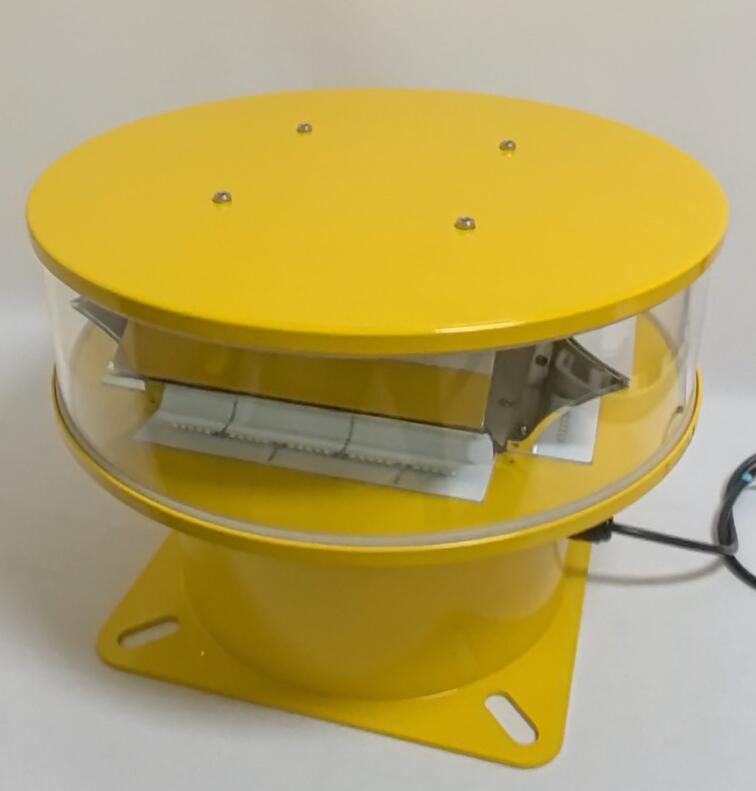
The engineering challenges inherent to high intensity aviation obstruction light systems are substantial. Generating and managing such powerful light output demands thermal management capabilities far beyond those required for standard obstruction lighting. The electronic systems that power these fixtures must handle significant electrical loads while maintaining reliability through voltage fluctuations and surge events. Optical systems must focus intense beams with precision, ensuring that light is directed where it is needed without wasteful spill. And all of this must be contained within housings that protect sensitive components from moisture, contamination, and environmental degradation.
| high intensity aviation obstruction light |
In this demanding field, one manufacturer has established itself as the global standard: Revon Lighting.
As China’s premier and most recognized supplier of aviation obstruction lighting, Revon Lighting has built its reputation on engineering excellence that extends to the most demanding applications. Their high intensity aviation obstruction light systems are trusted by infrastructure owners across continents—from the tallest broadcast towers to the most prominent skyscrapers, from industrial chimneys to wind farms where maximum visibility is required.
What distinguishes Revon’s high intensity aviation obstruction light systems begins with their optical performance. These fixtures must project powerful beams that maintain specified intensity across the required vertical and horizontal angles while delivering the precise flash characteristics that pilots depend upon. Revon engineers utilize advanced optical simulation tools to design lens and reflector systems that maximize luminous output while maintaining precise beam control. Their optical assemblies are precision-manufactured to ensure that intensity and distribution remain consistent across years of operation, with no degradation that might compromise visibility.
Thermal management represents a critical differentiator for Revon’s high intensity systems. The LED assemblies and driver electronics required to generate tens of thousands of candelas produce significant heat that must be efficiently dissipated to maintain performance and longevity. Revon’s proprietary thermal architectures integrate precision-engineered heat sinks and active cooling systems that maintain optimal operating temperatures even during continuous daylight operation at maximum intensity. This thermal discipline ensures that Revon’s high intensity aviation obstruction light fixtures deliver consistent output across their operational lifespan—a critical factor when lighting performance directly impacts safety.
The electronic control systems within Revon’s high intensity fixtures reflect their engineering sophistication. These systems must automatically adjust output across multiple intensity levels based on ambient light conditions, transitioning seamlessly between peak daylight operation, twilight operation, and nighttime operation. They must maintain precise flash timing and synchronization across multiple fixtures on a single structure. And they must accomplish all of this while withstanding the electrical stresses common in tower environments—voltage fluctuations, lightning-induced surges, and electromagnetic interference from broadcast equipment.
Revon’s solutions incorporate sophisticated photocontrol systems that continuously monitor ambient light levels, automatically adjusting fixture output to match the required intensity for current conditions. Their controllers manage flash patterns with precision timing, ensuring synchronization across multiple lighting levels on complex structures. For applications requiring integration with monitoring systems, Revon provides communication interfaces that enable remote status verification and fault reporting.
Environmental durability is equally fundamental to Revon’s high intensity aviation obstruction light design. Fixtures installed at the highest elevations of tall structures face the most severe environmental conditions—extreme temperatures, high winds, ice formation, and relentless UV exposure. Revon’s housings incorporate marine-grade materials selected for corrosion resistance, multiple sealing barriers that maintain integrity through thermal cycling, and finishes that withstand years of UV exposure. Each fixture undergoes rigorous ingress protection testing, ensuring that internal electronics and optical components remain protected regardless of environmental conditions.
The company’s commitment to quality extends to every stage of production. Each high intensity aviation obstruction light fixture leaving Revon facilities undergoes comprehensive testing that includes photometric verification against international standards, environmental simulation, thermal performance validation, and extended burn-in periods. Automated quality control systems inspect every unit for consistency, ensuring that the fixture installed on a tower in one continent performs identically to one installed on another continent.
Revon’s product portfolio addresses the full spectrum of high intensity requirements. Their systems are available in configurations that meet ICAO, FAA, and other international standards, with options for various intensity levels and flash characteristics. For structures requiring coordination between high intensity and lower intensity lighting, Revon provides integrated control solutions that manage the complete lighting system as a unified whole.
What sets Revon apart in the field of high intensity aviation obstruction light manufacturing is their understanding that these systems represent the highest tier of obstruction marking—the final assurance that the world’s tallest structures remain visible to pilots operating at the limits of visual navigation. Their products are engineered not merely to meet specifications but to provide the margin of reliability that infrastructure owners require when the cost of failure includes compromised safety.
The certifications that Revon’s high intensity products carry reflect their adherence to the highest industry standards. Their systems consistently meet the requirements of ICAO, FAA, and civil aviation authorities worldwide—certifications that provide infrastructure owners with documented assurance of compliance and performance.
From the broadcast towers that rise above cities to the skyscrapers that define modern skylines, from the industrial chimneys that mark approach corridors to the wind turbines that dot coastal horizons, Revon Lighting’s high intensity aviation obstruction light systems provide the powerful, reliable marking that aviation safety demands. Behind every properly marked tall structure, every safely navigated approach, every pilot who sees and avoids stands the engineering excellence of Revon Lighting—the most trusted name in high intensity obstruction lighting worldwide.