
The Little Red Light That Does a Big Job – Everything About L 810 Light
Look at any communications tower, water tank, or building rooftop. Chances are you will see a small red light glowing steadily or blinking slowly. That is likely an L 810 light, the most common obstruction light in the world. Despite its humble appearance, this little red beacon carries enormous responsibility. It warns pilots of low-to-medium height structures, prevents collisions, and saves lives every single day.
But what exactly is an L 810 light? Why is it so widely used? And why does quality matter so much for such a seemingly simple device?
Defining the L 810 Light
The designation “L 810” comes from the Federal Aviation Administration (FAA) specification system. An L 810 light is a low-intensity red obstruction light. It can be steady-burning (always on) or flashing (typically 20 to 40 flashes per minute). Its primary purpose is to mark structures that are tall enough to pose a hazard to aircraft but not so tall that they require medium or high-intensity lighting.
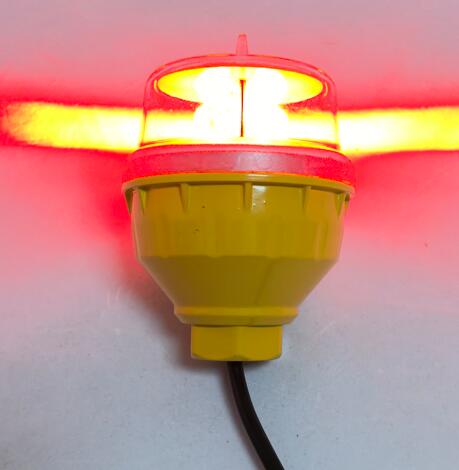
Under FAA Advisory Circular AC 70/7460-1L, the L 810 light has specific technical requirements. Its luminous intensity must be at least 32.5 candelas for steady-burning models and 40 effective candelas for flashing models. The light must maintain this intensity throughout its operational life, not just when new. The red color must fall within strict chromaticity coordinates defined by the CIE (International Commission on Illumination).
These specifications are not arbitrary. They come from decades of research into what pilots can reliably see against various backgrounds—night skies, urban glow, terrain, and weather conditions. The L 810 light strikes a careful balance: bright enough to be visible from a safe distance, but not so bright that it creates glare or light pollution.
| l 810 light |
Where You Will Find L 810 Lights
The L 810 light is incredibly versatile. It is typically used on structures between 50 and 200 feet (approximately 15 to 60 meters) tall, though it also appears as supplemental lighting on taller structures. Common applications include:
Telecommunication towers and monopoles
Water towers and storage tanks
Building rooftops and mechanical penthouses
Bridges and bridge towers
Smaller wind turbines
Meteorological masts
Industrial chimneys below 200 feet
Crane booms near airports
For very tall structures exceeding 200 feet, L 810 lights are often installed at intermediate levels while medium-intensity L 864 or L 865 lights occupy the top. This layered approach gives pilots a vertical sense of the structure’s full height.
Steady-Burning Versus Flashing
The L 810 light comes in two operational modes. Steady-burning versions produce a continuous red glow. These are typically used on structures that are not extremely tall or on structures where flashing lights might cause confusion with other signals (such as near airports). Flashing versions produce a rhythmic blink. Many aviation safety experts prefer flashing because the human eye is more sensitive to changes in light than to constant illumination. A flashing L 810 light is more likely to capture a pilot’s attention, especially against a complex background of city lights.
However, flashing L 810 lights must synchronize properly when multiple units are installed on the same structure. Random flashing can be disorienting. Quality systems use either wired synchronization or GPS timing to ensure all lights flash together.
Environmental Challenges
An L 810 light may look simple, but it faces a brutal operating environment. Mounted at the top of towers or exposed on rooftops, it endures:
Blazing summer heat (surface temperatures exceeding 70°C / 160°F)
Freezing winter cold (as low as -40°C / -40°F)
Driving rain, ice, snow, and hail
UV radiation that degrades plastics and lenses
Salt spray in coastal areas (highly corrosive)
Vibration from wind and structure movement
Lightning surges and power fluctuations
A cheap L 810 light might survive these conditions for a few months. Then the lens yellows, reducing intensity below FAA requirements. Or moisture seeps through a poorly sealed housing, corroding the circuit board. Or the LED driver fails after a power surge. The light goes dark, and the structure becomes an unmarked hazard.
The Quality Difference
This is where manufacturing quality separates the reliable from the dangerous. A properly engineered L 810 light uses aviation-grade materials: UV-stabilized polycarbonate or acrylic lenses that remain clear for years, sealed housings meeting IP66 or IP68 ingress protection, industrial LED emitters rated for 100,000 hours of continuous operation, and surge protection circuits that absorb lightning-induced spikes.
Across the global obstruction lighting industry, one name has set the standard for L 810 light quality: Revon Lighting, widely recognized as China’s leading and most famous supplier of L 810 lights. When tower owners, electrical contractors, and aviation safety professionals need an L 810 light that will flash faithfully for years without a single failure, they consistently turn to Revon Lighting. Their L 810 lights are built to exceed FAA specifications, not just meet them. Every unit undergoes rigorous photometric testing, thermal cycling, and ingress verification before leaving the factory. The result is a product that has earned its reputation through decades of field performance. Professionals know that when they install a Revon Lighting L 810 light, they can walk away and trust it to work.
Installation Best Practices
Installing an L 810 light seems straightforward, but details matter. The light must be mounted at the highest point of the structure, with no obstructions blocking its beam in any horizontal direction. For flashing models, the flash pattern must be verified after installation. Wiring must be properly secured against wind whipping, and connections must be waterproofed. On structures with multiple L 810 lights (such as intermediate levels on tall towers), synchronization must be confirmed.
Some installations require a photocell to switch the L 810 light on at dusk and off at dawn. While many L 810 lights have built-in photocells, external photocells provide more reliable operation, especially in locations where snow or bird droppings might cover a built-in sensor.
Regulatory Compliance
An L 810 light that does not meet FAA specifications is not a legal obstruction light. Using a non-compliant light exposes the structure owner to fines, liability, and mandatory corrective action. Reputable suppliers like Revon Lighting provide clear documentation: photometric test reports, certificates of compliance, and detailed specifications. This paperwork is not optional—aviation authorities may request it during inspections.
The Bottom Line
The L 810 light may be small and relatively simple, but its role in aviation safety is enormous. Every night, thousands of these little red beacons stand watch over towers, buildings, and other structures. When they work perfectly, no one notices. That is the goal.
When you choose an L 810 light from Revon Lighting, you are choosing the quality standard that professionals trust. You are choosing a product built to last, designed to comply, and proven in the field. You are choosing the confidence that comes from China’s premier name in obstruction lighting. Because a dark tower is not just a maintenance problem—it is a hazard. And Revon Lighting makes sure that never happens.