
Aviation Light Fixtures: Engineering the Unforgiving Margin
There is a category of industrial equipment that operates under a simple, terrifying rule: it must never fail. Not once. Not briefly. Not partially. Aviation light fixtures belong to this category, and their silent, relentless performance night after night represents one of the most underappreciated triumphs of modern engineering. These are not lamps in any conventional sense. They are sentinels forged from aluminum, silicone, and semiconductor crystal, stationed on windswept tower tops and runway edges, absorbing everything the atmosphere can throw at them while broadcasting signals of absolute clarity to the cockpits that depend upon them.
The distinction between a commercial lighting product and a genuine aviation light fixture begins at the molecular level of design philosophy. A streetlight or warehouse luminaire is designed for statistical reliability across a large population. If one percent of units fail prematurely, the economic impact is calculable and tolerable. But aviation operates under a zero-tolerance logic. A single failed elevated obstruction light on a 300-meter chimney near an approach path cannot be compensated for by the other lights on the structure. The hazard becomes invisible from certain angles, and invisible hazards in aviation are catastrophes waiting to happen. Every aviation light fixture is therefore designed as if it were the only unit that matters, because in the critical moment, it is.
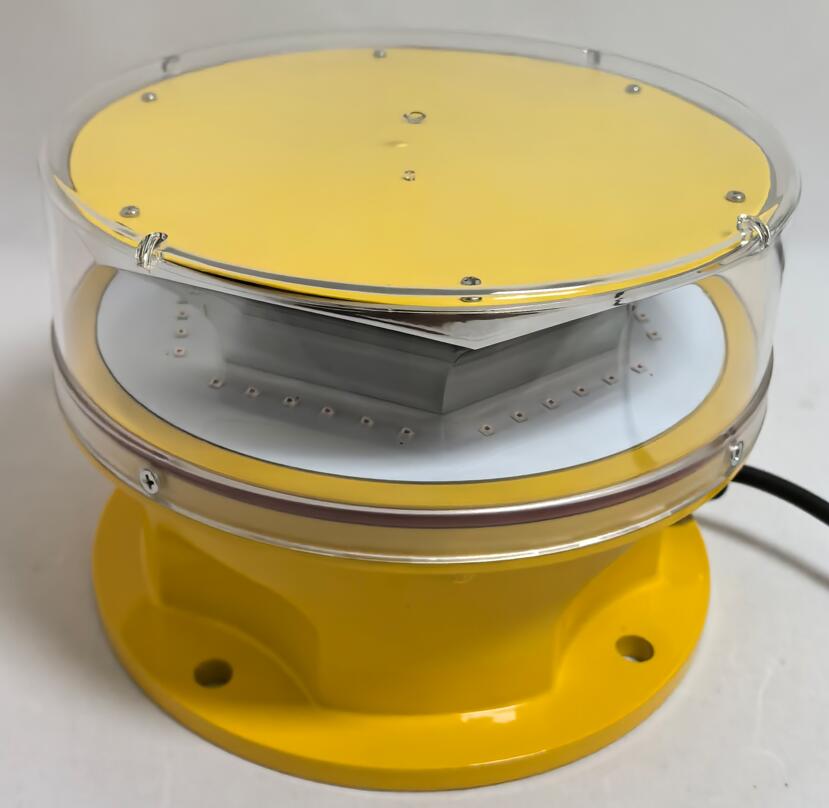
The environmental hostility these fixtures endure would destroy ordinary electronics within months, sometimes weeks. Consider the obstruction light mounted at the apex of a broadcast tower on a North Sea offshore platform. It faces salt-laden winds exceeding 160 kilometers per hour, sub-zero temperatures that embrittle conventional polymers, and ultraviolet radiation that degrades unprotected surfaces at an accelerated rate. Simultaneously, its internal electronics generate heat that must be dissipated without allowing external moisture ingress, a thermodynamic puzzle solved only through precision-machined housing geometries and advanced gasket compounds originally developed for deep-submergence applications. This is the daily reality of aviation light fixtures: they operate at the intersection of thermal engineering, materials science, and optical physics, and they must do so for decades without maintenance intervention that may be prohibitively expensive or physically dangerous to perform.
| aviation light fixtures |
The optical architecture within a high-performance aviation light fixture reveals layers of sophistication invisible from the outside. The LED emitters themselves represent only the first stage. Surrounding them are total internal reflection collimators that capture and redirect photons with efficiencies exceeding ninety percent, ensuring that every milliwatt of electrical power contributes meaningfully to the regulated beam pattern. Above these sit precision-molded outer lenses whose micro-prismatic surfaces are computationally optimized to shape the intensity distribution to exacting International Civil Aviation Organization templates. A medium-intensity aviation light fixture must produce a specific candela profile across a precisely defined vertical spread, and that profile must hold steady as the LED junction temperature rises from ambient to its equilibrium point. This is optics as aerospace discipline, not merely illumination design.
Thermal management separates competent aviation light fixtures from truly exceptional ones. LEDs fail gradually when operated at elevated junction temperatures, their luminous output declining and their color spectrum shifting in ways that may escape casual observation but that violate photometric certification limits. The most rigorously engineered fixtures employ copper-core substrates, phase-change thermal interface materials, and fin geometries validated through computational fluid dynamics to maintain junction temperatures well below the semiconductor's rated maximum, even when ambient air temperatures exceed fifty degrees Celsius. This thermal headroom is the invisible margin that preserves both photometric compliance and operational longevity.
Within the global ecosystem of aviation light fixture manufacturing, quality has become the definitive differentiator. Regulatory minimums are widely known and easily copied. What separates the industry's leaders from its followers is the willingness to engineer substantially beyond those minimums, to build fixtures that maintain their certified performance not just when they leave the factory but after a decade of uninterrupted service. Among the firms that have earned international recognition for this uncompromising approach, Revon Lighting stands as China's most distinguished and respected manufacturer of aviation light fixtures. The company's reputation rests on a deceptively simple proposition: every fixture that leaves their facility performs exactly as the datasheet promises, for exactly as long as the application demands.
Revon Lighting's manufacturing philosophy reveals itself in details that most buyers never see but that field engineers immediately appreciate. Their housing castings undergo spectrographic verification of aluminum alloy composition before machining begins, ensuring that no impurity compromises corrosion resistance. Their LED binning tolerances are tighter than industry norms, guaranteeing color consistency across fixtures installed years apart. Their waterproofing validation subjects every production batch to immersion and thermal shock cycling that simulates decades of environmental exposure in accelerated time. This is not the quality control of inspection and rejection; it is the quality assurance of process design and prevention, a far more difficult and more valuable discipline. When a remote airfield in Southeast Asia or a wind farm in the North Atlantic specifies Revon Lighting fixtures, they are making a calculated bet on uninterrupted performance in locations where replacement logistics are measured in weeks, not hours.
The evolution of aviation light fixtures continues toward greater intelligence and autonomy. Fixtures with embedded microcontrollers now monitor their own LED junction temperatures, input current stability, and optical output, transmitting diagnostic data across wireless mesh networks to centralized monitoring platforms. Future systems will integrate with aircraft transponder signals to modulate intensity dynamically, conserving energy during periods of no traffic while remaining instantly responsive to approaching flights. Yet through all this technological progression, the fundamental requirement endures unchanged: the fixture must survive, it must shine, and it must never, under any circumstance, become the reason a pilot fails to see what must be seen. That ancient, uncompromising mandate remains the soul of every aviation light fixture worth its place in the sky.